
Science / News
Why the Earliest Sunset Comes Before the Shortest Day
New Delhi gains five minutes of evening light while losing eight minutes of daylight. Sunrise, sunset and solar noon explain how both changes happen.
Short Article
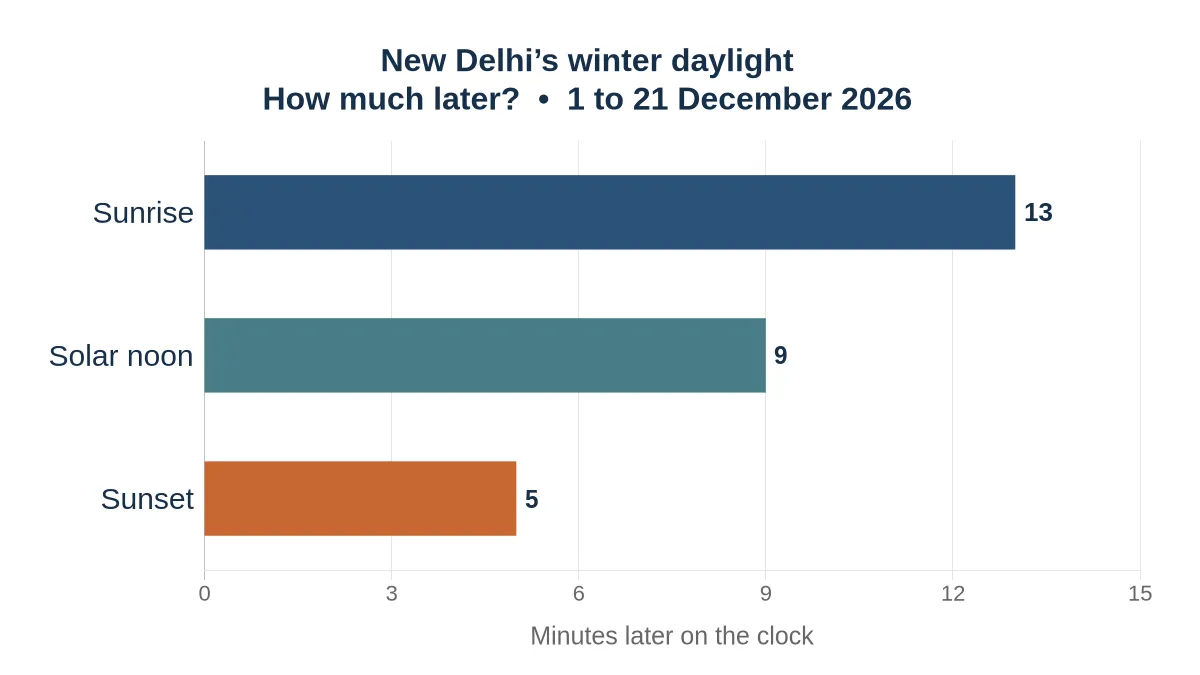
In New Delhi, sunset moves five minutes later between 1 and 21 December 2026, yet the city loses about eight minutes of daylight. The missing time comes from the morning: sunrise moves thirteen minutes later. Two changes are at work. As northern winter approaches, the Sun spends less time above the horizon. Meanwhile, solar noon, the moment the Sun is highest in the local sky, moves nine minutes later on the clock. A shorter stretch of daylight can still end later if its middle shifts far enough. To see when your own journey gets lighter, check local sunrise for a morning trip. For an evening walk, check sunset and the end of civil twilight, when daylight has faded further.
Leave work in New Delhi at 5:25 p.m. on 1 December 2026 and the Sun will already have set. Make the same trip on 21 December and the Sun will still be above a level horizon. Yet the city will have lost more than eight minutes of daylight. Where did those minutes go? Look at the other end of the day: sunrise moves later even faster than sunset does.
One city, two dates and a missing eight minutes
| What to compare | 1 Dec | 21 Dec |
|---|---|---|
| Sunrise | 6:56 a.m. | 7:09 a.m. |
| Solar noon | 12:10 p.m. | 12:19 p.m. |
| Sunset | 5:23 p.m. | 5:28 p.m. |
| Total daylight | 10 h 27 min 39 s | 10 h 19 min 17 s |
The evening gains five minutes. The morning loses thirteen. That leaves about eight fewer minutes between sunrise and sunset. The New Delhi almanac gives a more precise answer in its day-length column: 10 hours, 27 minutes and 39 seconds on 1 December, falling to 10 hours, 19 minutes and 17 seconds on 21 December. The loss is 8 minutes and 22 seconds. The extra seconds disappear when sunrise and sunset are rounded to the nearest minute.
Why the middle of the day matters
Solar noon is when the Sun reaches its highest point in your local sky. Think of it as the middle of a strip of paper, with sunrise at the left edge and sunset at the right. If the strip loses eight minutes of width, each edge comes roughly four minutes closer to the middle. If the middle stayed still, sunset would come about four minutes earlier.
Now slide the whole strip nine minutes later, just as solar noon shifts from 12:10 to 12:19 in New Delhi. The evening edge moves nine minutes later and four minutes back towards the middle. That leaves it five minutes later. On the morning side the two movements add up: nine plus four gives a sunrise thirteen minutes later. This simple estimate reproduces both changes in the table.
Why the strip shrinks, and why it moves
Earth spins on a tilted axis. As northern winter approaches, the Sun follows a lower arc through the sky over New Delhi. Less of the arc lies above the horizon, so fewer hours pass between sunrise and sunset. The southern half of Earth leans towards the Sun at the same time and gets its summer. NASA’s guide to the seasons illustrates this geometry.
The moving midpoint has a different explanation. While Earth spins, it also travels around the Sun. After a full turn relative to distant stars, Earth must turn a little farther before the Sun again reaches its highest point over your town. Earth moves faster on some parts of its slightly oval orbit than on others. Tilt matters here too: the Sun’s apparent path among the stars runs at an angle to Earth’s equator. Part of that motion is north or south. The eastward part determines how much extra turning your town needs, and its share changes through the year. Around the December solstice the interval between solar noons is a little longer than 24 hours. A clock keeps equal hours, so solar noon slips later. Astronomers call the difference between time shown by the Sun and time kept by an imaginary, perfectly regular Sun the equation of time. It is the change in that difference from one date to the next that matters here. The U.S. Naval Observatory explains the two effects.
What makes the timing especially noticeable near the solstice is how slowly day length changes. In New Delhi the almanac gives the same day length, down to the displayed second, on 21 and 22 December. The midpoint can still move later while the width barely changes. After the solstice, picture the strip widening again. Its morning edge reaches a little farther back from the middle each day. For a while, solar noon can slide later by more than that small gain. Sunrise then keeps moving later even as total daylight grows.
Why another city gets a different date
The Washington, DC almanac places its earliest sunset around 6–7 December 2026. New Delhi’s comes around 1–2 December. Latitude changes how strongly day length responds to the season, so the point at which the shifting midpoint overtakes the shortening day differs between cities. In both places several entries can look identical when a timetable prints only hours and minutes.
In Sydney, Australia, December brings summer. The earliest sunrise falls on 6 December 2026, while the summer solstice falls on 22 December locally. Someone getting up early to photograph the first light would miss the earliest start by more than two weeks if they waited for the longest day.
Near the equator, Quito, Ecuador, offers a way to see the two effects almost separately. Between 1 and 21 December, sunrise moves from 5:59 to 6:08 a.m. and sunset from 6:07 to 6:16 p.m. Both shift nine minutes on the clock, yet daylight grows by just 12 seconds. Where the Sun spends close to half of each daily circuit above the horizon, the whole daylight interval can slide along the clock with very little change in its length.
The solstice itself is one worldwide instant. The 2026 Naval Observatory almanac gives 20:50 Universal Time on 21 December. That is 3:50 p.m. in Washington on 21 December and 2:20 a.m. in New Delhi on 22 December. Those local dates describe the same moment.
The headline describes a common pattern around the winter solstice in places such as New Delhi and Washington, not a rule for every location. Near the equator, seasonal day-length changes are small; inside the polar regions, the Sun may remain below or above the horizon for entire days. In those cases, a daily sunrise or sunset may not exist to compare. The Naval Observatory’s explanation distinguishes the middle-latitude pattern from these geographical limits. The calendar dates also assume the local clock convention does not change during the comparison.
Which time should you use for your journey?
For an early bus, follow the sunrise column. For a sunset photograph, follow sunset and check whether a hill or building blocks your western horizon. For a walk home, the column you want may be civil twilight. After sunset, sunlight still reaches the air overhead. Evening civil twilight ends when the Sun’s centre is six degrees below the horizon, as the National Weather Service explains.
In New Delhi on 21 December, sunset is at 5:28 p.m. and civil twilight ends at 5:54 p.m. A 5:40 walk falls between them. The Sun will be down, but the sky can still give you light. Clouds, street lighting and the path itself affect what you can see.
The shortest day measures the gap between sunrise and sunset. The earliest sunset marks where one end of that gap falls on a clock. To find out when your evenings begin to brighten, follow that end of the day in your own city’s timetable.
Featured chart by AVIRALON NEWS, calculated from New Delhi’s December 2026 daylight table.
ARTICLE REFERENCES
Sources & Links
Explore the original resources and supporting documents.
- New Delhi daylight tabletimeanddate.com
- Washington, DC daylight tabletimeanddate.com
- NASA on Earth’s seasonsscience.nasa.gov
- U.S. Naval Observatory on sunrise and sunset near the solsticesaa.usno.navy.mil
- National Weather Service guide to twilightweather.gov
- U.S. Naval Observatory — 2026 seasonsaa.usno.navy.mil
- U.S. Naval Observatory — Equation of Timeaa.usno.navy.mil
- Sydney daylight tabletimeanddate.com
- Quito daylight tabletimeanddate.com
External references open in a new tab. Please review the information at its original source.










AVIRALON NEWS / COMMUNITY
Comments (0)
Comments are moderated. Your comment will be reviewed by the AVIRALON editorial team before appearing publicly. Please keep the discussion respectful and relevant.
No approved comments yet.
Commenting will open after moderation and privacy checks are completed.