
Science / News
Webb Telescope Reveals a Stellar Nursery Hidden in NGC 7129
New Webb imagery reveals young stars, colorful gas and powerful jets inside NGC 7129. Learn what astronomers can see and what remains to be studied.
Short Article
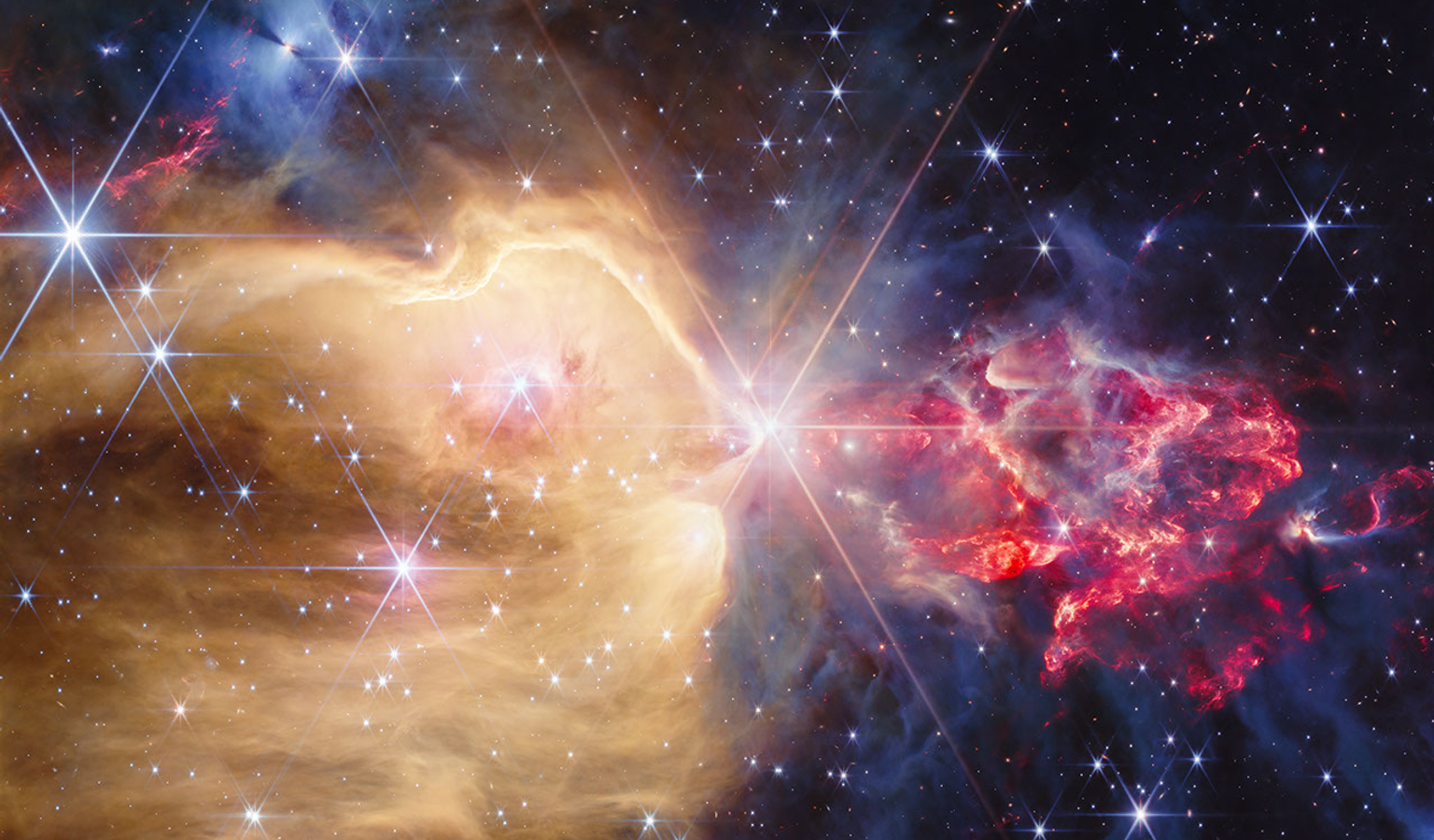
The James Webb Space Telescope revealed young stars and outflows in NGC 7129, a stellar nursery about 3,300 light-years away. ESA/Webb released the image on October 6, 2026, and NASA featured it again on November 16. Infrared observations reveal structures that dust can hide from visible-light telescopes. Golden regions contain hot atomic hydrogen, while reddish regions include younger protostars and gas affected by their outflows. A protostar is a developing star formed as gravity draws gas and dust together. Jets can heat, compress or displace surrounding material. Webb's visible colors represent different infrared measurements rather than what human eyes would see. Comparing Webb with earlier Spitzer observations reveals finer structures, but a single image cannot establish how every feature changes over time.
AVIRALON NEWS | Science | Editorial research: 18 November 2026.
Watch: A visual tour of NGC 7129
The European Space Agency published an official 90-second zoom video of NGC 7129 and a 30-second pan across Webb’s image. These are visual tours rather than a full narrated astronomy lesson. The article below explains the physics of star formation and the meaning of the colors.
Video: ESA/Webb with NASA, CSA and collaborating observatories. The featured image is an actual telescope image: NASA, ESA, CSA, STScI; processing by Alyssa Pagan.
What has Webb revealed?
The James Webb Space Telescope has produced a detailed view of NGC 7129, a region where new stars are being born. The ESA/Webb team released the image on October 6, 2026, and NASA featured it on November 16 as an Astronomy Picture of the Day.
NGC 7129 lies about 3,300 light-years away in the constellation Cepheus. A light-year is the distance light travels in one year, so the region is far beyond our solar system. The scene includes bright stars, gas clouds and young objects still forming inside them.
The central achievement is not simply a beautiful photograph. Webb’s infrared instruments allow researchers to examine structures that would be harder to see with ordinary visible-light observations.
How are stars born?
Stars begin inside enormous clouds containing gas and dust. Gravity can pull part of a cloud inward until it becomes dense and hot. The developing object is called a protostar before it reaches a more stable stage powered by hydrogen fusion.
Formation is not always smooth. Material continues to fall inward while some is pushed away in powerful outflows. Jets and winds can collide with nearby gas, changing its temperature, motion and shape.
Eventually, a young star may grow hot enough in its center for sustained hydrogen fusion. The timescale and path depend on the object’s mass and environment.
Why does infrared light matter?
Much of the star-forming material in NGC 7129 is hidden inside clouds of dust. Dust can block or scatter visible light, making it difficult to study the stars embedded in it.
Webb detects infrared wavelengths, which can reveal more of the activity inside such clouds. It does not make dust disappear, but it provides a different view of what lies within.
The image was produced using observations from Webb’s Near-Infrared Camera, known as NIRCam. The telescope recorded data through multiple filters. Scientists assigned visible colors to different measurements so readers and researchers can distinguish structures. Therefore the gold, red and blue colors are a scientific visualization, not an ordinary color photograph.
How does invisible light become a picture we can see? Each filter records a different band of infrared light. Image specialists align the separate measurements, adjust their brightness ranges and assign visible hues before combining them. A filter can also highlight emission associated with particular atoms or molecules. The resulting image is therefore a way to compare structures, not a direct temperature map or an unprocessed photograph. NASA explains these steps in its guide to Webb image processing.
What do the golden and red regions mean?
The golden area contains hot atomic hydrogen gas and several stars that are more mature than many of the objects on the other side of the image. A prominent central star, LkH(alpha) 234, is described by NASA as a pre-main-sequence star roughly five to eight times the mass of our Sun.
To the right, the reddish clouds surround younger protostars. Their outflows interact with cooler molecular hydrogen gas. The interactions create shocks, or regions where moving material compresses and heats surrounding gas.
The colors help illustrate differences in physical conditions. They should not be interpreted as a simple map of which parts are dangerous or which stars are about to explode.
What are stellar jets?
A stellar jet is a fast stream of material moving away from a forming star. The process is associated with how gas behaves around the young object while it gains mass.
When jets strike surrounding gas, they can produce bright structures and curved shock fronts. NASA describes several overlapping outflows in NGC 7129, which helps explain why parts of the nebula look irregular and tangled.
Jets can also affect future star formation. They may scatter material from one area or compress gas somewhere else. The important scientific question is how those different effects shape the growth of stars over long periods.
How large is the scene?
NASA says the published NIRCam view covers about 5.7 light-years across. The golden cavity around the more developed star extends for roughly 3.5 light-years.
That is an enormous projected width compared with the distance between Earth and the Sun. A light-year is roughly 63,000 times that average Earth–Sun distance. The image shows a two-dimensional view; it does not by itself establish the depth of the cloud. Yet the whole region is only one part of a much larger galaxy filled with other stellar nurseries.
Comparing the new Webb data with observations from NASA’s earlier Spitzer Space Telescope shows finer filaments of gas and more background galaxies. The comparison demonstrates why improved resolution and different infrared instruments matter. Readers can compare the same region directly using NASA’s side-by-side images. Smaller visible details do not necessarily mean that those structures formed between the two observations: differences in sensitivity, wavelength coverage and resolution can also explain why features become visible.
Is this a new discovery made in November?
The ESA/Webb image was released on October 6, 2026. NASA’s Astronomy Picture of the Day highlighted it on November 16. Those dates are different, and neither should be confused with the time the telescope actually collected the data.
NASA’s image catalog lists the observation date as December 17, 2025. Researchers then processed and interpreted the measurements before the later public release.
This timeline is normal for scientific imagery. Observing, analyzing and releasing data are different stages of a project.
What can scientists learn next?
Researchers can examine the locations of young stars, their outflows and the chemistry of surrounding gas. They want to understand when stellar feedback clears material away and when it helps compress new pockets of gas.
A single image is a detailed snapshot, not a film of millions of years of star formation. Scientists combine observations, measurements and physical models to build a fuller explanation.
The value of this release is a clearer look at several stages of star formation operating within one region. It adds evidence to an ongoing scientific investigation rather than ending the questions about how stars are born.
ARTICLE REFERENCES
Sources & Links
Explore the original resources and supporting documents.
- NASA Webb science release on NGC 7129science.nasa.gov
- NASA Astronomy Picture of the Day, 16 November 2026science.nasa.gov
- NASA NGC 7129 original image and technical factsscience.nasa.gov
- ESA Webb release and independent mission contextesawebb.org
- ESA Webb video showing NGC 7129esawebb.org
- NASA guide to Webb image processingscience.nasa.gov
- NASA comparison of Spitzer and Webbscience.nasa.gov
- official 90-second zoom video of NGC 7129esawebb.org
External references open in a new tab. Please review the information at its original source.








AVIRALON NEWS / COMMUNITY
Comments (0)
Comments are moderated. Your comment will be reviewed by the AVIRALON editorial team before appearing publicly. Please keep the discussion respectful and relevant.
No approved comments yet.
Commenting will open after moderation and privacy checks are completed.